
AI Use Case Prioritization Framework
Transform Your AI Investments from Spreadsheet Chaos to Strategic Portfolio

AI hype and FOMO is real and hot right now. Companies everywhere have established AI committees, allocated funding pools, and launched hackathons asking everyone to submit their brightest AI ideas. The question echoing through boardrooms? "Could AI do this?"
Pretty soon, AI use case spreadsheets mushroom across organizations—50 ideas become 100, then 200, then over 500. Teams scramble to comb through endless lists, interview submitters, hunt down data sources, and allocate resources. Months later, those lists keep expanding while evaluation criteria grow increasingly complex. Everyone's rushing to build AI prototypes, and IT departments struggle to support different platforms and tools sprouting like weeds.
After spending hundreds of thousands—sometimes millions—organizations find themselves drowning in an AI swamp, tangled in what I call "agent jungles." Then reality hits: the CFO demands to see promised savings. The Chief Risk Officer raises red flags about security and compliance. The Chief HR Officer struggles to identify actual AI talent, while data scientists watch in frustration as others attempt their work incorrectly. In the end, implementing AI often adds costs, and rarely does anyone volunteer to cut their budget because of newfound efficiency gains.
Sound familiar? You're not alone.
The Gold Rush Mentality is Killing Your AI Strategy
Organizations struggle with this chaos because they've jumped headfirst into the AI gold rush, frantically searching for "COULD." Could it be done by AI? Yes, absolutely. With today's rapid AI development, almost anything seems possible. But the critical questions are WOULD YOU and SHOULD YOU?
What works for Google or OpenAI won't necessarily work for your traditional manufacturing company or regulated financial institution. These tech giants have fundamentally different business models, infrastructure, and workforce capabilities than most organizations.
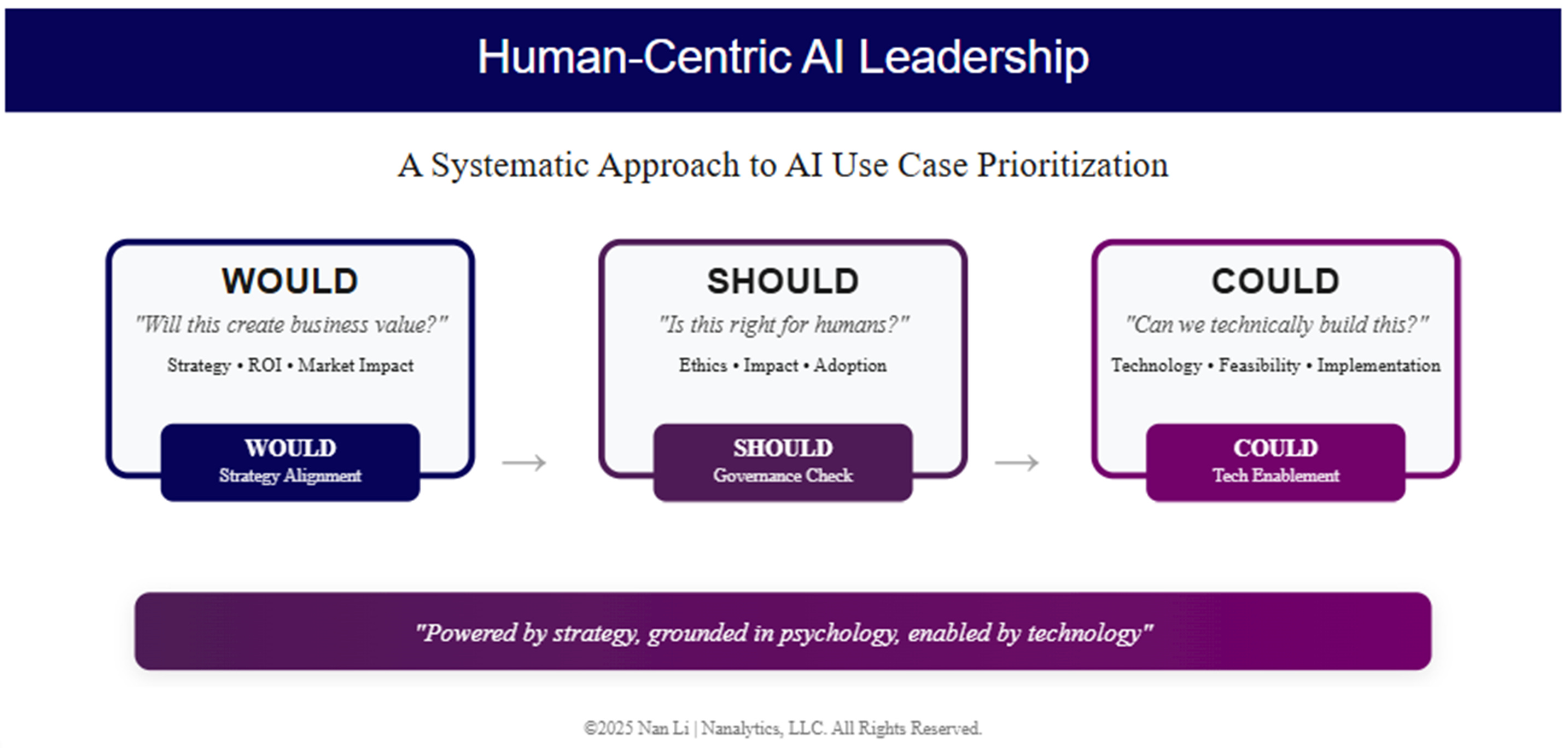
What struggling companies lack is alignment—alignment with their business models, strategic priorities, technical capabilities, and organizational maturity. Instead of asking "Could AI do this," smart leaders begin with "Would we do this according to our strategic priorities?" and "Should we do this based on our guiding principles and regulations?" The technical "Could" question should come last.
Think of it this way: just because you could invest your entire retirement savings in cryptocurrency doesn't mean you should. Smart investors evaluate risk tolerance, investment timeline, and financial goals before choosing specific investments.
Turning Questions Into Scoring Frameworks
While these three strategic questions provide clarity, you need a systematic way to evaluate and score your AI use cases. Think of this like developing a credit score for AI projects—standardized criteria that eliminate guesswork and political maneuvering.
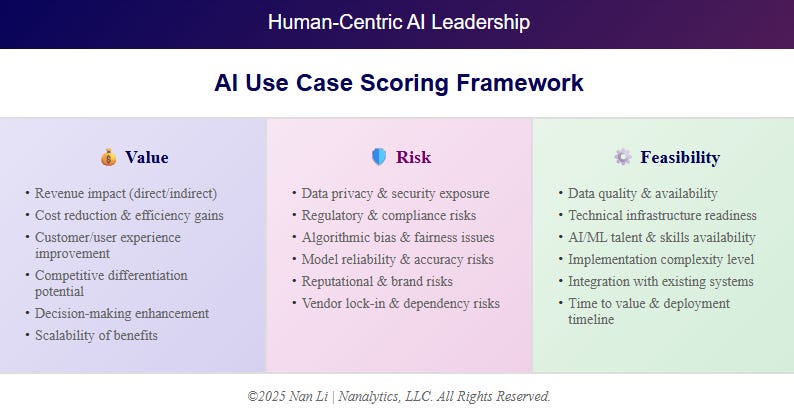
💰 WOULD - Value Assessment measures revenue impact, cost reduction potential, customer experience enhancement, operational efficiency gains, competitive differentiation, and decision-making improvements.
🛡️ SHOULD - Risk Evaluation examines data privacy exposure, regulatory compliance risks, algorithmic bias potential, model reliability concerns, reputational risks, and vendor dependencies.
⚙️ COULD - Feasibility Analysis considers data quality, technical infrastructure readiness, AI talent availability, implementation complexity, system integration challenges, and realistic deployment timelines.
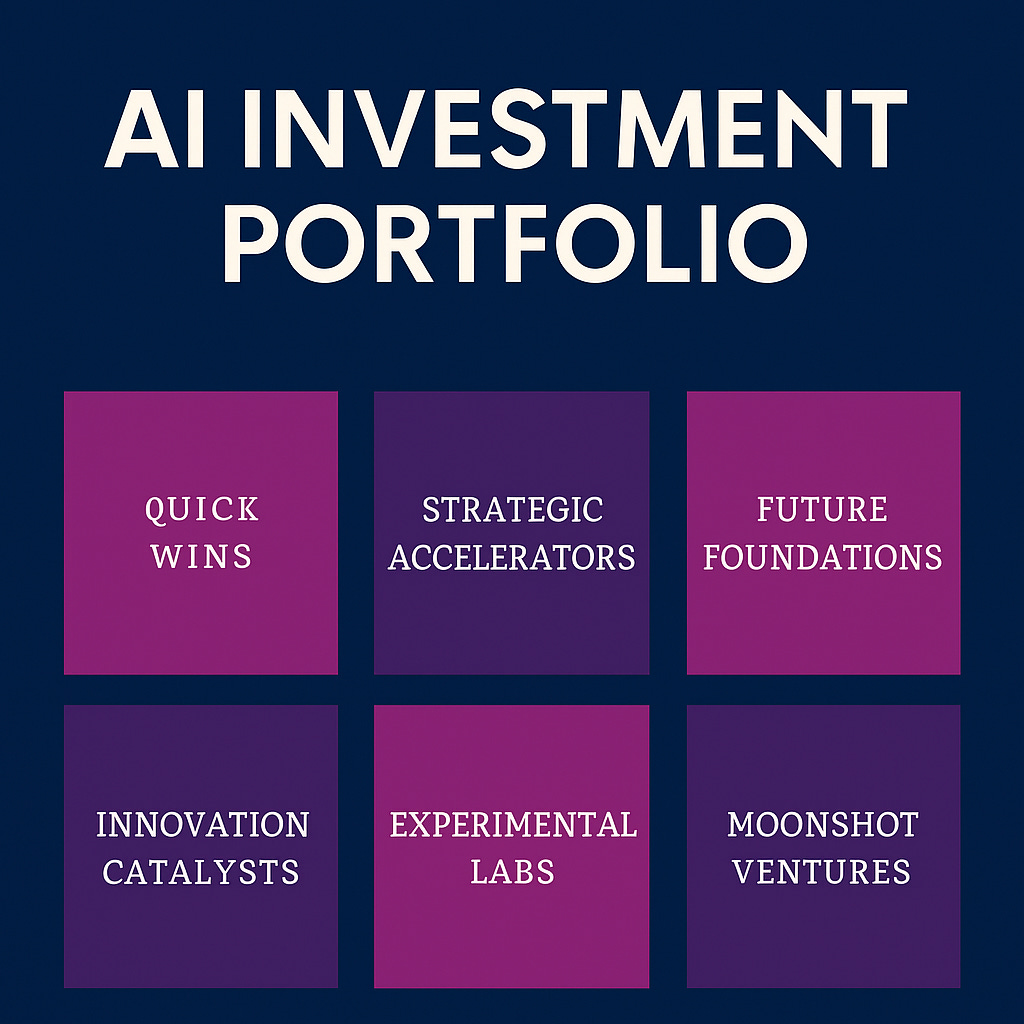
Your AI Investment Portfolio Strategy
After scoring your use cases across these three dimensions, you'll still likely have a substantial list. Now comes the portfolio approach—categorizing your AI initiatives just like a diversified investment portfolio, balancing risk and return across different asset classes.
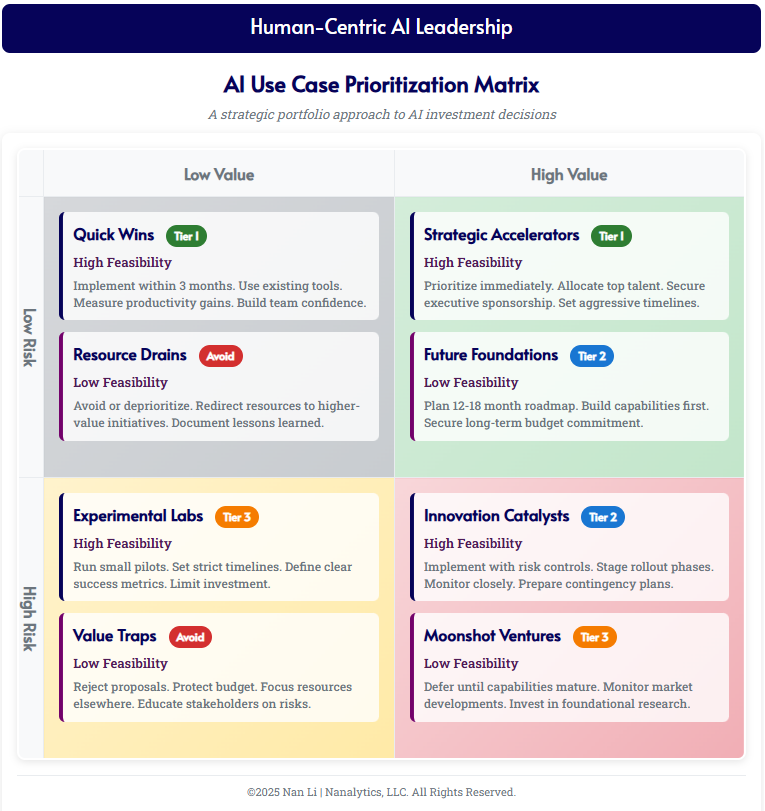
Quick Wins: Your Money Market Account (Low Value, Low Risk, High Feasibility)
Safe, reliable, modest returns. Examples include meeting notes automation, document processing, and basic customer service chatbots. Start here to build organizational confidence, establish governance frameworks, and develop your AI operational muscles. While these won't differentiate you from competitors, they're essential for learning data quality requirements, user adoption patterns, and change management approaches.
Strategic Accelerators: Your Blue-Chip Stocks (High Value, Low Risk, High Feasibility)
Your S&P 500 of AI investments. Think coding assistants for software companies, fraud detection for financial services, or predictive maintenance for manufacturers. The challenge? If something truly delivers high value with low risk and immediate feasibility, you might wonder why it hasn't been implemented already. These golden opportunities often require deep industry expertise to identify and execute properly.
Future Foundations: Your Growth Investments (High Value, Low Risk, Low Feasibility)
Like emerging market funds, these initiatives aren't immediately executable but offer significant long-term potential. Examples include AI drug discovery for pharmaceutical companies, advanced supply chain optimization, or real-time language translation for global healthcare systems. These require 1 - 3 years or even longer roadmaps, dedicated R&D teams, and long-term budget commitments, but they'll differentiate you from competitors over time.
Innovation Catalysts: Your Call Options (High Value, High Risk, High Feasibility)
These projects offer massive upside potential but carry significant execution risk. Think AI-powered personalized treatment protocols, novel risk assessment models, or real-time content personalization engines. Like call options, they require careful management—strict A/B testing, expert oversight, and the ability to pivot or withdraw quickly if results don't materialize.
Experimental Labs: Your Play Money (Low Value, High Risk, High Feasibility)
Your "play money" allocation for innovation sandbox projects. Many breakthrough discoveries emerged from seemingly low-value experiments. Examples include AI-generated internal presentations, intelligent meeting schedulers, or chatbots that simplify complex concepts. Set clear timelines and success metrics, treating this as your "fail fast" laboratory for building AI literacy and fostering creative thinking.
Moonshot Ventures: Your Cryptocurrency Bets (High Value, High Risk, Low Feasibility)
Your highest-risk, highest-reward investments. Developing proprietary large language models, building AI systems for completely isolated environments, or creating entirely new AI-powered business models fall into this category. Only pursue moonshots when you have substantial resources, deep technical expertise, and unwavering conviction about your vision.
Investment Traps to Avoid
Resource Drains are like perpetually low-yield bonds—they consume time and money without delivering meaningful value. AI-powered coffee machine optimization when your real challenge is employee engagement represents this trap. Value Traps combine high risk with low feasibility and minimal value—like a financially struggling person attempting to day-trade options. Reject these proposals immediately and redirect resources toward higher-impact opportunities.
Your Implementation Strategy
Building this framework is just the beginning. Success requires cross-functional teams to develop specific metrics for quantifying value, risk, and feasibility. Examine your portfolio allocation—are you overly concentrated in quick wins, or diversified across all categories? Like any investment strategy, there's no universal answer; it depends on your risk appetite, timeline, and expected returns.
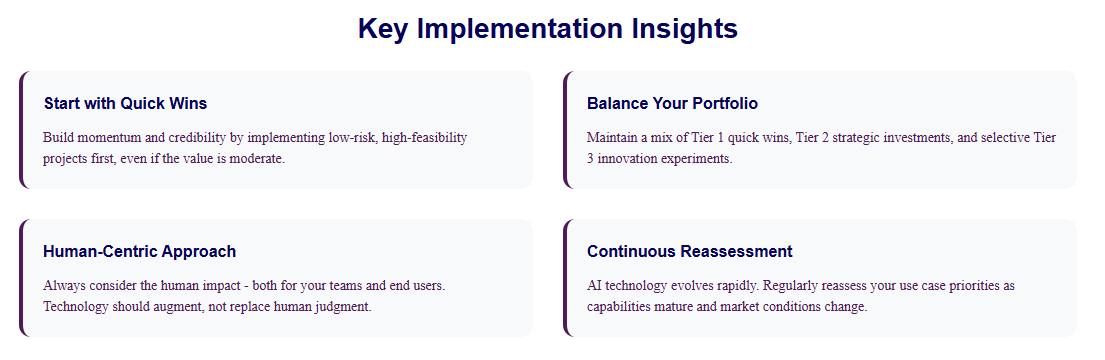
Start with Quick Wins to build momentum and organizational credibility. Even moderate-value projects teach valuable lessons about data quality, user adoption, and governance while establishing your AI operational foundation.
Balance Your Portfolio strategically. Maintain a mix of Tier 1 quick wins, Tier 2 strategic investments, and selective Tier 3 innovation experiments. Diversification reduces overall risk while maximizing learning opportunities across different AI applications.
Maintain a Human-Centric Approach throughout implementation. Technology should augment human judgment, not replace it entirely. Focus intensively on stakeholder adoption and change management from day one, ensuring your AI initiatives enhance rather than threaten your workforce.
Reassess Continuously as AI capabilities evolve rapidly. What constitutes a moonshot today might become a strategic accelerator tomorrow. Regular portfolio reviews ensure your investments remain aligned with both technological possibilities and business priorities.
The Path Forward
The companies that will maximize returns from AI investment won't be those with the longest use case spreadsheets or the most prototypes. They'll be organizations that learned to think like sophisticated portfolio managers—asking the right strategic questions, making disciplined investment decisions, and aligning AI initiatives with their unique organizational capabilities and constraints.
Stop drowning in AI possibility and start building AI strategy. Transform your overwhelming spreadsheet of ideas into a focused, balanced portfolio that delivers measurable business results while managing risk appropriately.
Ready to transform your AI chaos into strategic advantage? I've helped organizations move from overwhelming use case spreadsheets to focused, high-impact AI portfolios using this framework. Whether you're struggling with prioritization, governance, or AI investment strategy, let's discuss how this approach can work for your organization. Contact me at nan.li@nanalyticsai.com or use this link to schedule a free consultation.
Nan Li is a human-centric AI thought leader, advisor, coach, and speaker. She helps organizations implement AI strategy and governance, and conducts AI mindset coaching and training that amplify human expertise. She also helps individuals make sense of AI for their leadership or career development. Connect with her insights on building strategic AI capabilities at Nanalytics AI or follow her on LinkedIn, or visit her website at www.nanalyticsai.com.